
Classic lorem ipsum
The standard for centuries: Latin-looking filler text that distracts from content and keeps all eyes on the layout. Optionally starting with the famous line "Lorem ipsum dolor sit amet …".
Free · no sign-up · runs entirely in your browser
Placeholder text, filler copy and dummy content – the Latin classic, pangrams for font testing, or text cut precisely to a target length. Your text never leaves the browser.
History The last 10 results of this session. One click restores settings and text faithfully. The history is discarded when you close the page.
The standard for centuries: Latin-looking filler text that distracts from content and keeps all eyes on the layout. Optionally starting with the famous line "Lorem ipsum dolor sit amet …".
Sentences like "The quick brown fox jumps over the lazy dog" contain every letter of the alphabet. The classic way to check a typeface completely – nothing gets missed.
Text cut precisely to characters or words. With ready-made presets for meta title, meta description, tweet and SMS – no more counting characters by hand!
Number sequences, prices, percentages and complete table rows in English or German formatting. Handy for calculators, price boxes and table layouts.
Generates a semantically clean HTML skeleton with h1 to h3 headings, plus paragraphs, list, quotes and tables – as source code to copy or as a rendered preview.
Uppercase, lowercase, digits, special characters and umlauts wildly mixed. Instantly shows whether a font renders every glyph cleanly – and whether l, I and 1 can be told apart.
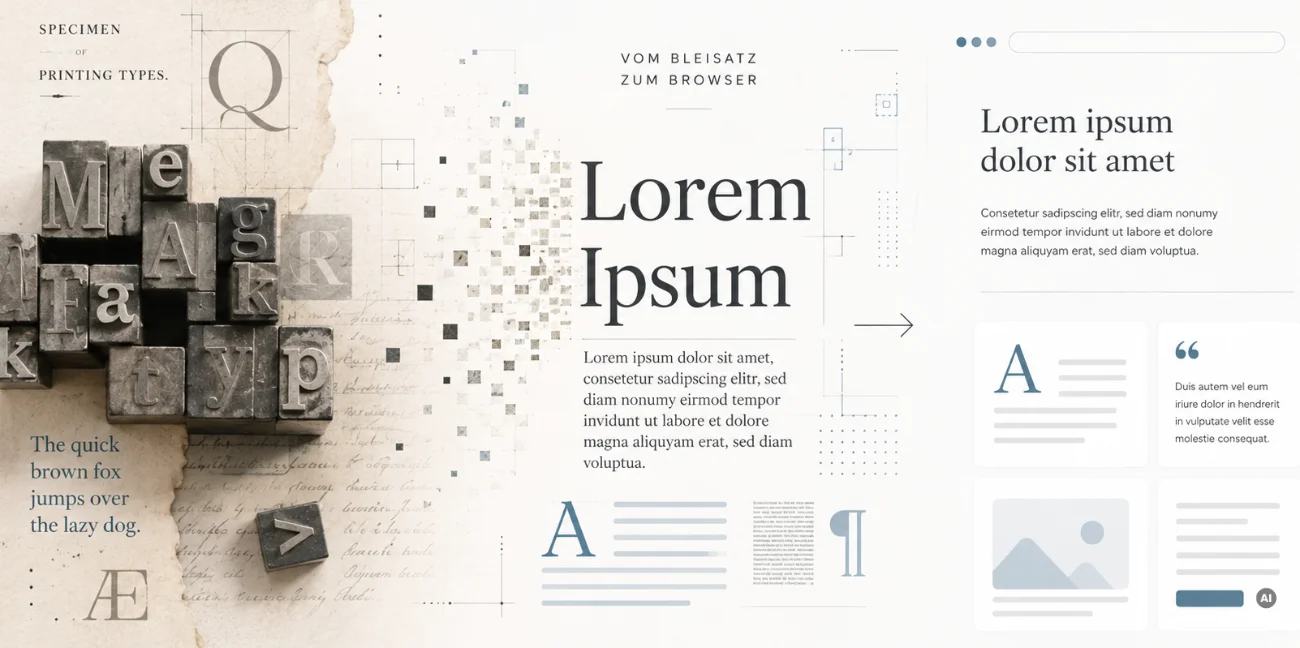
Lorem ipsum is probably the best-known placeholder text in the world – and much older than most people think. The word sequence is based on a scrambled passage from "De finibus bonorum et malorum", a treatise by the Roman philosopher Cicero from 45 BC. An unknown typesetter probably jumbled the text as early as the 16th century to set type specimens. Since then, the pseudo-Latin has survived every technological shift: hot metal, phototypesetting, desktop publishing and finally the World Wide Web. Even in the AI era it still has its place!
The clever part: lorem ipsum looks like real text but cannot be read along casually, so it shifts the focus elsewhere. That is exactly why it works so well – nobody gets stuck on the content, everyone looks at the layout.

You could, but it instantly looks artificial. Try comparing it with lorem ipsum! Real body copy has words of varying length, commas, capitalisation and varying sentence lengths. Only with that does a draft show how lines break, whether paragraphs look too grey and whether the chosen font size is even readable. A placeholder made of repeated words produces a completely unrealistic type texture. Try it – the difference is striking!
Placeholder text is not an end in itself but a tool: it simulates the statistics of real language without distracting from the design.
In short: in drafts yes, on the live site please no. As long as filler text only lives in mockups, staging environments or design tools, Google never sees it. If lorem ipsum slips onto a published page, things get awkward: search engines detect placeholder text reliably, rate the page as unfinished, and visitors bounce. In the worst case "Lorem ipsum dolor sit amet" even ends up as a snippet in the search results …
Our tip from practice: before your new website goes live, search the entire site and code for "ipsum" once. Takes ten seconds and has prevented many an embarrassment.
The Latin standard text uses only part of the alphabet – letters like j, k, w, x and z barely appear, if at all. Test a typeface with it and you may feel falsely safe: everything looks clean until real copy arrives and suddenly a glyph is missing or renders oddly (more common with exotic web fonts than you would think).
That is exactly what the pangram mode is for: sentences like "The quick brown fox jumps over the lazy dog" contain every single letter. Font gaps, spacing issues and rendering quirks show up in the draft – not in front of your client.
Placeholder text right in your build process, seeds or automated tests? A simple GET request delivers fresh text as JSON or plain text – directly, with no API key and no sign-up. Every response also automatically includes an attribution to our site.
GET https://loremipsum-generator.org/api?type=lorem¶graphs=3&format=json
Yes, without restriction. All placeholder texts, number sequences and HTML skeletons created here may be used privately and commercially – for example in drafts, templates, presentations or software. An attribution is appreciated (so our tool can remain free), but is not required. That way, others can benefit from our free tool too!
Only half. The words come from a genuine Cicero text of 45 BC but were mangled and reshuffled. Even the very first word "Lorem" is just the remainder of "dolorem" (pain). That is why the text cannot be meaningfully translated – and that is exactly the point.
Rule of thumb: as much as the real content will occupy later. For a text column, 2 to 3 paragraphs of 60 to 100 words each usually suffice; for teasers, more like 30 to 50 words. When in doubt, test both extremes – very short and very long text – and you will see immediately whether the layout copes with both.
No. The generator runs entirely as JavaScript in your browser. Settings and generated text are never transmitted to us and are not stored anywhere. Only the optional developer API generates text server-side – and only when you actively call it.
Practically nothing – they are different names for the same thing: text without real meaning that stands in for future content in drafts. Print traditionally says dummy or blind text, web designers tend to say placeholder or filler text. This tool generates them all.
Usually it comes down to length and character set: the real copy is longer or shorter than the placeholder, or it contains characters and long words the Latin filler does not have. Two remedies are built right into this tool: the target-length mode (text at exactly the desired length) and the pangram mode that exercises the full alphabet.
Yes. A simple GET endpoint is available at /api, delivering placeholder text as JSON or plain text – no sign-up, with a fair-use limit of 120 requests per hour. All details and code samples are in the API documentation. The response automatically includes an attribution to loremipsum-generator.org.